

Paints from minerals and stones
- Pragati Gunasekar

- May 24, 2019
- 6 min read
Updated: Mar 10, 2023
For centuries, artists have been using a wide variety of materials to create paints, including minerals and stones. These natural pigments can produce unique and stunning colors that cannot be found in traditional paints. In this blog, we will explore the history of using paints made from minerals and stones.
Mineral pigments gained popularity throughout the Middle Ages. Ultramarine and azurite were particularly popular, with artists such as Michelangelo and Rembrandt using these pigments.
History
The use of natural pigments for paint dates back to ancient times. For example, the Egyptians used minerals such as malachite and lapis lazuli to create their iconic blue-green and deep blue colors. The Greeks and Romans also used natural pigments for their murals and frescoes.
During the Renaissance, artists began using natural pigments to create vivid colors and achieve realistic effects. The famous Dutch painter Vermeer used natural pigments such as ultramarine, made from lapis lazuli, to create his iconic blue hues.
Benefits
Using natural pigments for paint offers several benefits.
First, they are environmentally friendly and sustainable. Unlike synthetic pigments, natural pigments are non-toxic and do not harm the environment. They are also renewable resources, as they can be sourced from minerals and stones that are abundant in nature.
Second, natural pigments produce unique and vibrant colors. Each mineral and stone has its own chemical composition, which gives the paint a distinct color and texture. For example, hematite produces a deep red color, while azurite creates a bright blue-green hue.
Finally, natural pigments have a longer lifespan than synthetic pigments. They are resistant to fading and retain their vibrant colors over time. This is due to the natural stability of the mineral and stone pigments.

12 naturally-occurring pigments
Carbon Black
Ochre
Lead white
Azurite
Malachite
Orpiment
Realgar
Verdigris
Vermillion
Ultramarine
Indigo
Woad
Carbon Black
Carbon black is one of the earliest pigments created by human beings. Carbon black is often found under aliases "Vine Black" or "Lamp Black", which refer to the way it was historically obtained - Vine Black was created by charring vines, and oil lamp soot is also the main ingredient of traditional ink. Early fifteenth-century Japanese sumi-e drawings, such as the beautiful Landscape of the Four Seasons, are attributed to Tensho Shubun.

Ochre
Natural ochre is a blend of quartz sand, clay, and the mineral iron oxide. The pigment is obtained from ochre in a simplistic process of sublimation.

Ochre has never fallen out of favor with artists. In fact, the finest ochre pigments were sought after for their natural effect and versatility.
Lead white
Lead white is a warm, shiny color, in its oil paint form, it dries the quickest of all whites and provides good flexibility on canvases. Here's one example of a well-renowned artist that I was really overwhelmed "chiaroscuro figures by Caravaggio". Gosh! It looks like a picture shoot in a DSLR with a very high ISO. It's really amazing how Caravaggio was able to visualize such an amazing image and painted this (image below).
Chiaroscuro is an Italian word (meaning "light-dark") referring to the modeling of volume by depicting light and shade by contrasting them boldly. This is one means of strengthening an illusion of depth on a 2D surface. This was an important topic among the artists of the Renaissance.
One of my friends, a cinematographer, told me there are two parts to cinematography. One is the art part and the other is the technique. The art part of it heavily influences cinematography. He had asked me to read up on how paintings heavily influence shooting cinematic/dramatic videos or films. It is really overwhelming to know how these paintings are such an inspiration to create films of today's age.

Another notable example is Vermeer's luminous interior scenes(image below).

Azurite
Azurite, also known as 'bice blue' or 'blue vernier, is a naturally occurring mineral that has been used as a pigment since Egyptian times. It is one form of mineral copper sulfate.
The exterior frescoes at the Voronet Monastery(image below), built in 1488 by Prince Stephen the Great in only three months and three weeks, give a great example of using azurite as a pigment. This remains blue for over 550 years, despite being exposed to the elements in the air.

Malachite
Malachite, alongside azurite, is one of two naturally occurring basic copper carbonates. The copper ores react to carbonate components of neighboring materials, such as limestone, to produce colorful crystals. The Malachite Room of the Winter Palace, St Petersburg, was designed in the late 1830s by the architect Alexander Briullov. The room obtains its name from the use of malachite for its columns and fireplace.

The use of malachite pigment declined with the introduction of oil paint in Europe in the 16th century, as it created a poor transparent mix when the powder was suspended in oil.
Orpiment
Made up of intricate, orange, yellow, and golden colored crystals. Once crushed and processed, orpiment produces a warm, radiant yellow pigment. Artificially manufactured and pure orpiment pigments were used throughout the 19th century, with notable examples including many of the works of JMW Turner - Chichester Canal (image below).

In both natural and artificial forms, should be done infrequently to avoid its toxic effect and repulsive, noxious fumes.
Realgar
Realgar derived from the Arabic for 'powder of the mine' is a deep orange pigment created from a fiery mineral of the same name. Realgar thrives in sites of hot natural water and is found commonly in springs and volcanic rock passages.

Used to a much lesser degree than orpiment due to its toxic nature, there are far fewer surviving examples of realgar's use in art throughout the ages, except a very few like by Tiziano Vecellio aka Titan (image above).
Verdigris
The pigment verdigris is derived from copper acetate, the same patina which coats aged coins and copper roofs. This is my favorite color and my favorite part of history. The name verdigris originates from the Old French verte grez, (green of Greece). Artworks featuring this pigment didn't suffer the otherwise corrosive effect, instead have been known to burn holes through parchment. It dulls and blackens over time.
In oil paints, and with conscientious use of appropriate varnishes, verdigris becomes increasingly stable and, arguably, more powerful. This was one of the most used greens in Mediaeval, Renaissance, and Baroque oil paintings. Below is the painting - by Raphael, ‘Saint John the Baptist Preaching’, 1505, which has a story to it and also a deconstruction of every pigment used in this painting, including verdigris.

Vermillion
Vermillion was one of the first pigments to be synthetically replicated. Vermillion has been highly prized for its royal hue. This is a naturally occurring mineral from which this pigment is obtained is cinnabar, a deep red ore of mercury, found in volcanic areas.
Among the numerous artists, Britain's most notoriously colorful modern painter, JMW Turner- The Scarlet Sunset (image below).

Ultramarine
Ultramarine, a vivid, deep blue pigment, is derived from lapis lazuli. Obtaining this pigment form the mineral is an intricate and prolonged process during which the lapis lazuli is ground to a powder and combined with resin, gum, wax, and linseed oil. This ancient, natural process produces inconsistently shaped crystals, structures that create a multidimensional and multi-reflective.
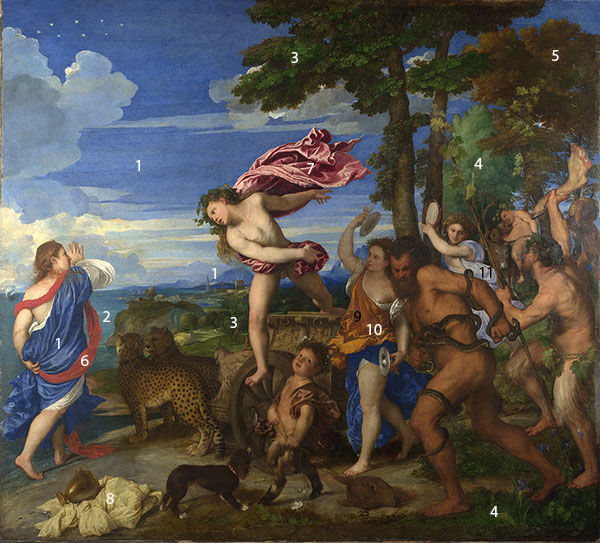
By the 16th century, artists had started to be more experimental with ultramarine. One of the most notable paintings was by Titian - Bacchus and Ariadne. The analysis of this painting can be found here.
"Titian manages to extract the maximum amount of drama out of the story, largely through the dynamic postures adopted by his two main actors. But equally important are their swirling draperies with their luminous blue and rose tones - Titian's two favourite colours. At any rate, the composition is filled with movement and colour."
Indigo
This pigment is obtained from the raw material in a lengthy process; after being dried out the leaves are rolled and crushed against the volcanic rock. This drying process is likely to have originated in India, as the color's name implies the word 'indigo' is probably a derivative of the Greek indikon, which originates from India.
Woad
Woad was the most lucrative and important blue dyestuff in Europe until Indigo eventually arrived from Asia. This bluish-green paint is smeared over the bodies of the ancient Celtic warriors preparing for the battle in order to appear fierce and threatening. Its story is intrinsically linked to many human histories; it is the blue of Egyptian mummies' cloth wrappings and European illuminated manuscripts.

Conclusion
In conclusion, using natural pigments for paint has a rich history and offers several benefits. They are environmentally friendly, produce unique and vibrant colors, and have a longer lifespan than synthetic pigments. Natural pigments made from minerals and stones continue to be used by artists today, creating stunning and unforgettable works of art.


Comments