

My visit to Van Gogh Museum, NL
- Pragati Gunasekar

- Mar 6, 2023
- 6 min read
Updated: Mar 10, 2023
In this blog, we will explore Van Gogh's sources of inspiration and how they shaped his artistic vision. He traveled to many places and befriended many painters, some of them who were his great source of inspiration.
Nature
One of the most significant sources of inspiration for Van Gogh was nature. He was deeply connected to the natural world, and he believed that it was a source of great beauty and wonder. Van Gogh would often venture outside to capture the changing colors of the sky and the land. He was particularly drawn to the vibrant colors of the countryside, which he believed were more alive than the dull grays of city life.
Van Gogh's paintings of sunflowers, wheat fields, and olive groves are iconic examples of his love for nature. His use of vivid colors and bold brushstrokes captured the essence of the natural world and conveyed its power and beauty.
People/Pesants
Van Gogh was also inspired by the people around him. He believed that art should reflect the human experience, and he was fascinated by the lives of ordinary people. He often painted portraits of peasants, laborers, and other working-class individuals, capturing their unique personalities and struggles.
In his paintings, Van Gogh conveyed the humanity and dignity of ordinary people, depicting them with respect and empathy. His portraits are characterized by their emotional intensity and expressive brushwork, which brings his subjects to life.
Emotions
Another important source of inspiration for Van Gogh was his own emotional state. He suffered from mental illness throughout his life, and his paintings often reflect his inner turmoil. He used color and brushwork to express his feelings of joy, sadness, and despair, creating works that are both beautiful and deeply moving.
Van Gogh's use of color is particularly noteworthy. He believed that color could convey emotions and moods, and he used it to great effect in his paintings. His use of bright, intense colors such as yellows, blues, and reds gave his paintings a sense of energy and intensity that was unlike anything seen before.
Other Artists
Finally, Van Gogh was inspired by other artists. He studied the works of the Impressionists, such as Monet and Renoir, and was particularly drawn to their use of color and light. He also admired the bold brushstrokes of the Post-Impressionists, such as Gauguin and Seurat, and incorporated their techniques into his own work.
Van Gogh's artistic vision was unique and deeply personal, reflecting his own experiences and worldview. His paintings continue to inspire and captivate audiences around the world, a testament to his enduring legacy as a master painter.
Vincent Van Gogh's Life
Dutch artist Vincent Van Gogh started his career as an art dealer when he was as young as 16. Vincent didn't find his direction in life until he was 27 years old. Eventually, he found his calling for art on the advice of his younger brother Theo. He died at the age of 37. During these 10 years of painting, he created over 900 paintings. Van Gogh is one of the most influential figures not only in the area of Post-Impressionism but in the whole of Western art history.
Post-Impression refers to a genre of painting that rejected the naturalism of Impressionism, in favor of using color and form in more expressive manners.

Painter of Peasant Life
He was inspired by painters like Jean-Francois Millet, Jules Breton, and Jozef Israels, Van Gogh decided to make peasant life his main subject.

In Van Gogh's early years as an artist, Anthon van Rappard proved indispensable as a friend and colleague. Van Rappard began working on this group of tile painters around a table in 1883. Van Gogh followed his progress closely.
"As for your tile painters - I was interested to hear that you are working on it again - I'm especially interested in what it's like and what it will become."
Just like his friend, Van Gogh hoped to paint a monumental group composition of ordinary people.


Vincent combined his hard work on “that thing with the peasants around a dish of potatoes in the evening” with chain smoking and a poor diet. Most of his money went to artists’ materials. Later that year, he decided to enroll at the academy of art in Antwerp and left the Netherlands, never to return.

This old peasant’s cottage, seen at dusk, gives a peaceful, idyllic picture of rural life. Van Gogh was fascinated by such peasant dwellings, which he called ‘human nests.’ This cottage, with its double front doors and split chimney, actually housed two families. One of them was the De Groots, who posed for The Potato eaters.
I shot this video of the original painting at the museum in Amsterdam, Netherlands. The bright stroke of yellowish orange sunset and brush strokes mesmerized me.
New Inspiration in Antwerp and Paris

He introduced his brother to the colorful work of prominent modern artists like Claude Monet. Vincent van Gogh also got to know a new generation of artists at Fernand Cormon’s studio, including Henri de Toulouse-Lautrec and Emile Bernard.
From the hill of Montmartre, Van Gogh painted the southerly view of Paris. He created depth in the composition by making the roofs and chimneys in the foreground seem close by. Further away, the outlines of monumental buildings are visible in the city center. Panthéon, Louvre, Notre Dame; all of them have been identified.
Van Gogh made the buildings fairly large and detailed in proportion to the rest of the landscape. He probably used a telescope. There are still telescopic viewers on the hill so that tourists can take in the view.

I shot this video of the original painting at the museum in Amsterdam, Netherlands. The composition and brush strokes mesmerized me.
Inspiration from Japanese Paintings

Meanwhile, he discovered a new source of inspiration in Japanese woodcuts, which were sold in large quantities in Paris. Vincent and Theo began to collect them. The influence of the bold outlines, cropping, and color contrasts in these prints showed through immediately in his own work.
Van Gogh greatly admired Japanese woodcuts for their bright colors and distinctive compositions. He based this painting of a bridge in the rain on a print by the famous artist Utagawa Hiroshige. Van Gogh made the colors more intense than in the original, however. He painted this work on a standard-size canvas.
Inspiration from South France
Vincent's time in South France was a turbulent period in his life. In Arles from 1888 to 1889, he made 187 paintings and drawings. He fell ill and cut off his ear, but he kept working despite everything. During this time, he even made some of his most famous artworks.
Some of my favorite paintings by Van Gogh during this period.


Working together with Paul Gauguin
Van Gogh and Gauguin worked hard together and their collaboration resulted in some exceptional paintings. At the same time, however, the two men had very different views on art, which led to frequent, heated discussions:
'Gauguin and I talk a lot about Delacroix, Rembrandt &c. The discussion is excessively electric. We sometimes emerge from it with tired minds, like an electric battery after it’s run down.'
Vincent to Theo, Arles, 17 or 18 December 1888
The end of a dream
He remembered little about the ear incident and when he was discharged from the hospital in early January 1889, he resumed painting. In the months that followed, however, his mental health fluctuated sharply. Fearing a fresh bout of illness, he had himself voluntarily admitted to Saint-Paul-de-Mausole psychiatric hospital in Saint-Rémy in May.
Painting Despite illness
Vincent van Gogh spent one year in the mental hospital in Saint-Rémy-de-Provence. Despite his unstable mental health, he was very productive: he made about 150 paintings in a year, including Almond Blossom.

Watch this video to find out how Van Gogh's production in Saint-Rémy is related to his illness:
Van Gogh's Art was appreciated towards to end of his life
'How pleased I would have been if you’d been there at the Independents’ exhibition. […] Your paintings are well-placed and look very well. Many people came up to ask me to give you their compliments. Gauguin said that your paintings are the key to the exhibition.'
Theo to Vincent, Paris, 19 March 1890
Inspiration from rural Auvers-sur-Oise, North of Paris.
Vincent threw himself entirely into his painting in this period, completing virtually a work a day. His health seemed to be improving, too.


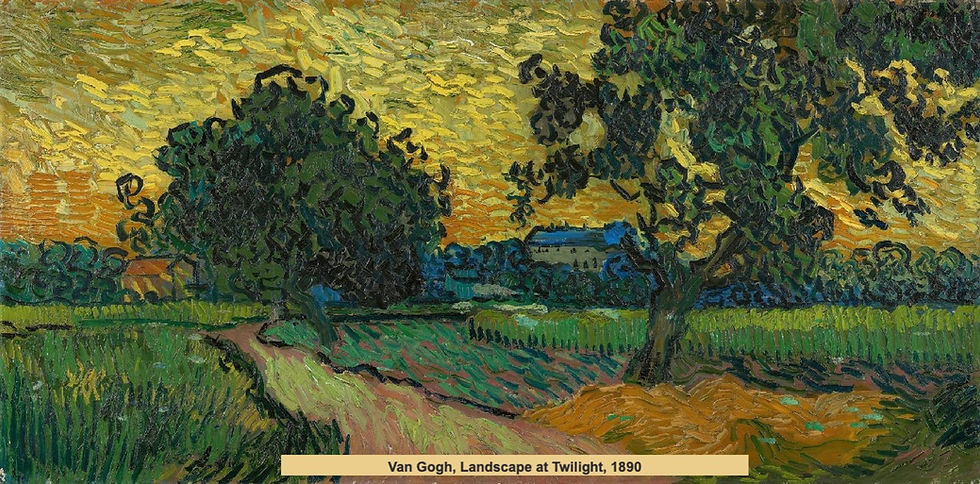
I shot this video of the original painting at the museum in Amsterdam, Netherlands. The composition and brush strokes mesmerized me.
Money worries and Suicide
'Once back here I too still felt very saddened, and had continued to feel the storm that threatens you also weighing upon me. What can be done – you see I usually try to be quite good-humoured, but my life, too, is attacked at the very root, my step also is faltering. '
Vincent to Theo, Auvers-sur-Oise, around 10 July 1890
'. . . knowing clearly what I wanted I’ve painted another three large canvases since then. They’re immense stretches of wheatfields under turbulent skies, and I made a point of trying to express sadness, extreme loneliness. You’ll see this soon, I hope – for I hope to bring them to you in Paris as soon as possible, since I’d almost believe that these canvases will tell you what I can’t say in words, what I consider healthy and fortifying about the countryside.'
Vincent to Theo, Auvers-sur-Oise, around 10 July 1890
The Van Gogh Museum
After his death, Vincent’s fame grew, however, there were calls for the collection to be placed in a dedicated museum. Eleven years later the works were moved from the Stedelijk Museum to a specially designed building by Gerrit Rietveld. Two million people now visit the museum every year.


Comments