

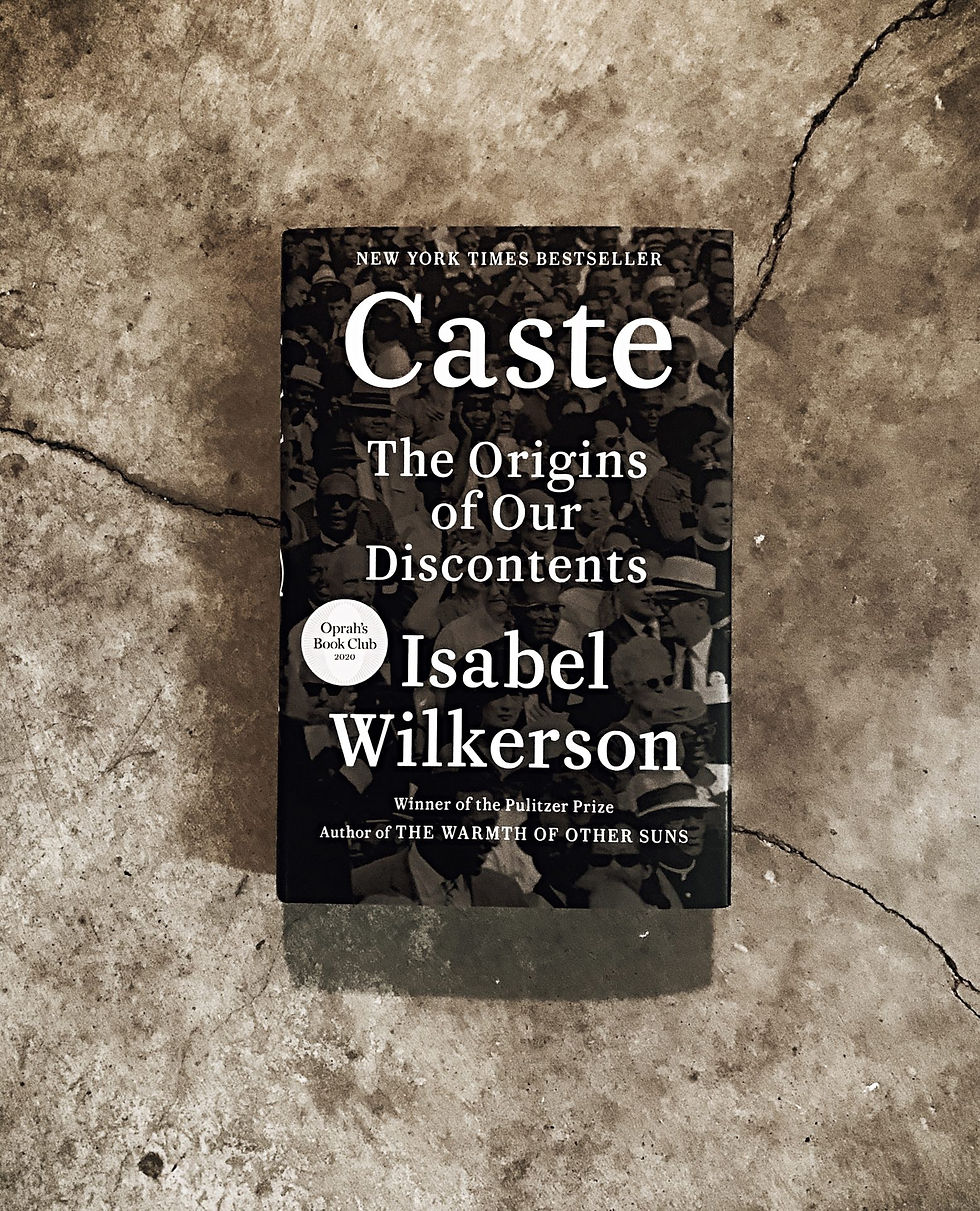
"Caste: The Origins of Our Discontents" by Isabel Wilkerson
- Pragati Gunasekar

- May 30, 2024
- 4 min read
Here's my review of Isabel Wilkerson's book "Caste: The Origins of Our Discontents". This book is a profound and meticulously researched exploration of the hidden caste systems that shape societies, particularly in the United States. In this compelling work, Wilkerson delves into the intricate and often invisible hierarchies that dictate the social, economic, and political lives of individuals, drawing parallels between the caste systems in India, Nazi Germany, and America.
Understanding Caste Beyond Race and Class
Wilkerson’s central thesis is that caste, a rigid and enduring system of social stratification, underpins and perpetuates racial and class inequalities. She argues that while race and class are visible markers of difference, it is the deeper, more insidious caste system that cements these divisions and dictates individuals' opportunities and outcomes. By comparing the American caste system to the more explicitly defined caste systems in India and Nazi Germany, Wilkerson provides a comprehensive framework to understand the pervasive nature of caste in human societies.
Key Themes Explored
Historical Context and Comparison:
Wilkerson meticulously traces the origins and evolution of caste systems, highlighting the historical parallels between the American racial hierarchy, the Indian caste system, and the Nazi regime's racial policies. This comparative approach elucidates the universal mechanisms of oppression and social control.
The Eight Pillars of Caste:
Wilkerson outlines eight foundational pillars that support caste systems worldwide. Her analysis of these pillars reveals how caste systems are constructed and maintained over generations:
1.Divine Will and the Laws of Nature:
This pillar justifies the caste system as a natural order, often ordained by divine will. It suggests that the hierarchy is preordained and immutable, making it appear as an integral part of the universe.
2. Heritability:
Caste status is inherited at birth and passed down through generations. This pillar ensures that one's social status and opportunities are determined by ancestry rather than individual merit.
3. Endogamy and the Control of Marriage and Mating:
Endogamy requires people to marry within their caste, preventing the mixing of castes and maintaining clear boundaries. This pillar controls social relationships and perpetuates caste divisions.
4. Purity vs. Pollution:
This concept distinguishes the castes by associating higher castes with purity and lower castes with pollution. It justifies the exclusion and segregation of lower castes and reinforces social hierarchies through rituals and taboos.
5. Occupational Hierarchy:
Caste systems assign specific occupations to different castes, often reserving the most prestigious and desirable jobs for higher castes. This ensures economic advantages for the upper castes and restricts the lower castes to menial or degrading tasks.
6. Dehumanization and Stigma:
Dehumanization portrays lower-caste individuals as inherently inferior and unworthy of respect or dignity. Stigmatization enforces social ostracism and justifies discriminatory practices and violence against lower castes.
7. Terror as Enforcement, Cruelty as a Means of Control:
Violence and terror are used to enforce the caste system and maintain social order. This includes physical violence, intimidation, and psychological abuse to keep lower castes in their place.
8. Inherent Superiority vs. Inherent Inferiority:
This pillar instills a belief in the inherent superiority of the dominant caste and the inherent inferiority of the lower castes. It perpetuates the notion that social hierarchies are justified and natural.
Impact on Individuals and Society:
Through compelling narratives and personal stories, Wilkerson illustrates the profound impact of caste on individuals' lives. She explores how caste shapes identities, restricts opportunities, and perpetuates inequalities, affecting everything from healthcare and housing to education and employment.
Contemporary Relevance:
Wilkerson connects historical caste systems to contemporary issues, demonstrating how the legacy of caste continues to influence modern societies. She discusses the ongoing struggles against systemic racism, discrimination, and social injustice, emphasizing the need for awareness and action.
Strengths of the Book
Rich Storytelling: Wilkerson's use of personal anecdotes and historical narratives brings the abstract concept of caste to life, making it accessible and relatable to readers.
Interdisciplinary Approach: The book draws on history, sociology, psychology, and anthropology to provide a multifaceted understanding of caste, making it a comprehensive resource for readers from various backgrounds.
Comparative Analysis: By examining multiple caste systems, Wilkerson highlights the universal patterns of social hierarchy and oppression, encouraging readers to recognize and challenge these structures in their societies.
Criticisms and Limitations
Complexity and Density: Some readers may find the book's detailed analysis and extensive historical context overwhelming. The depth of research, while thorough, can sometimes slow the narrative pace.
American Focus: Although the book parallels other caste systems, its primary focus is on the American context. Readers looking for an in-depth analysis of non-American caste systems may find this limiting.
Conclusion
"Caste: The Origins of Our Discontents" by Isabel Wilkerson is a groundbreaking work that challenges readers to confront the deeply embedded caste systems that shape our world. Through rigorous research and compelling storytelling, Wilkerson exposes the hidden hierarchies perpetuating inequality and calls for a collective reckoning with these structures. This book is essential for anyone seeking to understand the roots of social injustice and how we can work towards a more equitable society.


Comments